September 16, 2022

What Use is Poetry?


In Meena Alexander's poem “Question Time,” she writes, “What use is poetry?” and “We have poetry so we do not die of history.” Poetry can provide a documentary, an artistic investigation at the same time that poetry can become an ode sung to the beauty and resilience of the landscape and its people. The landscape of northern Minnesota is unique because the Northern Continental Divide crosses the Laurentian Divide, creating three watersheds. Water flows north to Hudson Bay, south to the Mississippi, and east to the Great Lakes and St. Lawrence River/Seaway. In this water-rich place, mining of iron ore and taconite has removed billions of tons of earth. This region is now at risk of copper sulfide mining.  

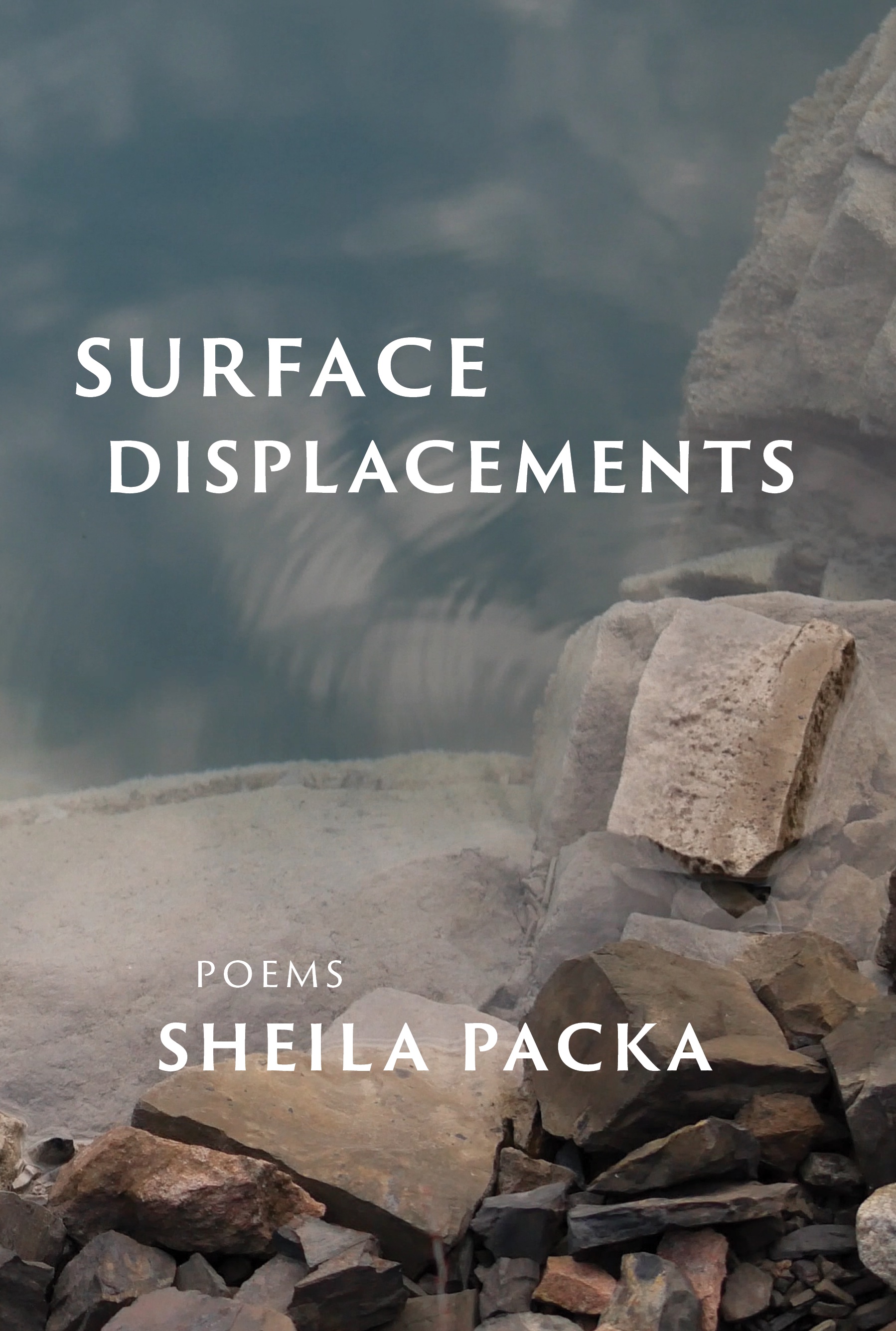
The poems in my book explore displacements of many kinds: of land, people, language, and wildlife. Poems document events such as floods and erosions, flights of birds and snail trails, mine pits and lakes, laborers and excavations for the removal of minerals. Poems go in, under and through waterways, in boats, into memory and history. 

The title poem of Surface Displacements is a long poem that gathers images of displacement, waterways, and brief narratives of immigrants crossing by water and land. One can’t help being aware of people who are displaced: immigrants fleeing war, violence, climate conditions, or otherwise untenable situations. Or not just immigrants, homeless people who wander the streets of every community. There are many reasons that they are there: poverty, trauma, mental disorders, and/or addictions, Battered women often must flee their homes in order to find safety. Teenagers sometimes find themselves on the streets as runaways from family violence or dysfunction. The migration of people is as steady as the migration of birds. 

Poetry is a language inside the language. In a poem in next to no time, years can collapse. Whole eras can elide into a few lines, or one moment can be forever held still. Poetry has underwater currents or forces. Muriel Rukeyser says “poetry can extend the document” in a footnote to her poems in “The Book of the Dead,” a section of her 1938 book titled U.S. 1. It is about the Hawks Nest Tunnel disaster in Gauley Bridge, West Virginia, which killed at least 476 coal miners, mostly African American migrant workers, between 1930 and 1935. Her poems incorporate archival material about the mining disaster with lyric intensity. The title alludes to the Egyptian Book of the Dead and the Mayan Book of the Dead, evoking the power and weight of those ancient funerary texts. In this way, the form of a poem along with its sound patterns, images, associations, and metaphors can bring together the said and unsaid. On a page, a poem has empty spaces that can be understood like the negative space in a drawing. Stanza breaks might be viewed as bends or turns in a river. Line endings in a poem form a shoreline to launch from and land upon, an empty and wave-washed beach, an edge where we can hold the losses and make new paths, where we search and find things new.


See more about the book at www.wildwoodriver.com

QUILT: Read Between the Lines

In some ways, writing a book of poems is similar to making quilts. Often I write poems in response to visual art or music. These are called ekphrastic poems. Lately, I've been honored to learn others are using my poems to create music and visual art.  The composer Wendy Durrwachter recently received a grant to create a piece of music based on the title poem of my book, Surface Displacements.  

The quilt artist Leslie Hughes created this piece of art after reading my book, Surface Displacements.  Hughes' quilt is hand stitched and titled "Read Between the Lines."  To thank her, I sent her a poem Quilt, published in The Mother Tongue. 


QUILT by Sheila Packa 


old garments cut into pieces
stitched into the fabric
so many women

cutting scraps into corners
into houses into entire lives
held with thread

pulled by the sharp needle
one eye
closing on the world

the way it was
the way it is
with an underside

a pattern not completed
fraying yet being mended
by hands

always being useful
washing, pressing out
the wrinkles

finding what shapes
will fit together
gathering into circles

to fasten the layers
over the hard frame
talking secrets

over the design
the thimbles click
the knots are tied


July 29, 2022

Upcoming Readings - Fall 2022


October 19, 2022, Wednesday, 6:00 pm.  Poet Laureate Reading at the University of Minnesota Duluth, Kathryn A. Martin Library, featuring Sheila Packa and Dani Pieratos.  Ellie Schoenfeld and Tina Higgins Wussow.  

October 27, 2022, Thursday, 7:00 pm, Quaker Meeting House, Duluth, Minnesota. Bart Sutter and Sheila Packa poetry reading. Piano by David From. Reception to follow.  

November 6, 2022, Sunday, 3:00 pm. Nordic Center, Lake Avenue, Duluth, MN.  Book launch! Sheila Packa reading from her new book, Surface Displacements, along with an art installation. Art talk: Confluences: Writing, Composing, Making Art from Art by poet Sheila Packa, composers Sara Pajunen, Wendy Durrwachter & Kathy McTavish, & quilt artist Leslie Hughes. 

November 9, 2022, Wednesday, 5:00 pm, Fond du Lac Tribal and Community College, Cloquet, Minnesota.  Sheila Packa, reading from new book, Surface Displacements.  Reception at 4:30 pm.  This event at 5 pm can also be viewed live on Zoom. Here is the link: https://minnstate.zoom.us/j/4618587742


The Craft of Writing

The Craft of Writing, a conference sponsored by Wisconsin Writers Association, is happening on September 30 and Oct. 1, 2022 at Barkers Island Inn & Conference Center in Superior, Wisconsin. I'm on a panel "Tips and Tricks for Writing Across Genres" with four other great writers: Jan Jensen (fiction), Christy Wopat (nonfiction/memoir), Dale Botten (screenwriting), and Chris Monroe (children's book author/illustrator.   There are also wonderful presentations and opportunities to meet people and talk about the craft of writing. 

Follow this link to see the detailed schedule.  Register today! https://wiwrite.org/Fall-Conference-2022


June 5, 2022

Talking About A Poem

Poem
"I don't like poetry," some people say. Others say they don't understand it, and that's why they avoid it.  

So, how does one read a poem?  I like to look at the beginning line and the end line to see where the poet enters and where the poet leaves.  

In this wonderful poem by Adam Zagajewski, the opening line immediately has a narrator ("I"), action, and setting. The I might be the poet himself, or it might be a persona that the poet has created for this narrative.  Ambiguity in a poem is common. It allows the reader to find more than one meaning.  "I" could even refer to the reader. 

Then, the pronoun "you" refers to the souls of the dead. The poem appears to be addressed to the souls.  The narrator asks "where are you?" It is an existential moment, definitely.  After the question, the forest images predominate. Using figurative language, the narrator says, "I heard the green leaves dream./ I heard the dream of the bark from which/ boats, ships and sails will arise."  Figures of speech, or figurative language, is characteristic of many poems. Metaphors use one thing to explain something else.  Imaginative images and scenes like this give the reader a vision of time and beautiful transformations.  Then the birds come in "on the balconies of branches," each singing a unique song "...not asking for anything, with no bitterness or regret,/"  Here the birds are described in human terms.  

Next, a turn. A leap. In a sonnet, this shift is called a volta. I like to think of this moment as similar to a bend in the river that brings you to a new vista.  It brings us to the ending: "I realized you are in singing..." The ending line has a new pronoun, not "I" or not "you" which have occurred in the earlier lines, but "we."  The word signals a shift. Now the narrator and souls are drawn together as a we, or perhaps it's the narrator and audience or readers that are drawn together.  It's a satisfying answer to the initial question.  

Repeated words, phrases or images are important. Rhythm and sound are important, because all of this forms a kind of music. In this poem, it is a call and response form. "Where are you? ....Where are you?"  and "I heard...  I heard..."   and then, "...you (souls of the dead) are in singing,/ unseizable as music, indifferent as/ musical notes, distant from us/ as we are from ourselves."

Unseizable. A lovely word and a lovely rhythm in this phrase. Notice the line breaks. A line break does create a sort of pause, a hesitation, and here the line break that occurs after "distant from us" (of course, the birds are distant because they are far above and of course souls of the dead are far) does something new. There is a subtle shift, for the next line reads "as we are from ourselves." Now that's surprising. The poet is saying that we don't know ourselves, that we have parts of our being we cannot easily reach, and perhaps we cannot ever reach. The ambiguity expands meaning. He might mean himself, he might mean the reader.  

A poem like this captures a moment, a place, and a person who has longing. It speaks of spiritual truths to the reader: we have loss, a connection to the souls of the dead. We have lost loved ones, friends, people in our community, and we have also been aware of an internal loss, the inability to know our own self, our connection to our own being.  The phrase "Where are you?" now takes on this new meaning.  

In just a few lines on the page, this poem says so much concisely. The words and images have beauty.  One poet said that poems are made of forces.  If so, what are the forces operating inside this poem?  There are no definitive answers, no right interpretation or wrong interpretation, only things to ponder. There are impressions. Resonances. Echoes. There is breath. There is light and music.  


To find out more about this poet, go to https://poets.org/poet/adam-zagajewski


May 22, 2022

It's Here! Surface Displacements


Surface Displacements has become a finalist for the Minnesota Book Award in February 2023, 

Read my new work published by Wildwood River Press! These poems travel through mining excavations and waterways vulnerable to environmental contamination and climate change in Minnesota, where the Northern Continental Divide crosses the Laurentian Divide and creates three watersheds that flow into the Mississippi River, the Great Lakes, and Hudson Bay. These are stories and images, historical and contemporary, about people who are displaced, whose language is replaced, and who find a fluid space full of possibility.

The cover is an aerial image by Sara Pajunen, and the book design by Kathy McTavish. 

Available through any bookstore or at https://www.wildwoodriver.com/
We also love to support independent bookshops or  https://bookshop.org/books 

ISBN 9781947787360

Praise for the book

“In Surface Displacements, the spirit of the ancient Finnish shamans breathes again. Sheila Packa’s best early poems recalled her youth on Minnesota’s Iron Range, growing up in households where Finnish was still spoken, where the immigrant towns were gritty working-class, in a landscape of mine pits, forests, and water. That environment remains her fundamental source, though now everything has changed, changed utterly, as Packa has learned, with increasing confidence, to incorporate history, science, and myth, even as her language has grown more musical, her poems more spiritual. Like the old shamans, she has become a shapeshifter, able — through the dreamy trance of poetry —to speak in the voice of a snail, rivers and lakes, an entire landscape and its people.” —Bart Sutter, author of So Surprised to Find You Here

“There is a beckoning, a teaching, a singing and lamenting in Sheila Packa’s Surface Displacements. In rivers, headwaters, displacement and the otherworld we are given ways of navigating earth’s trauma in the sink and rise of all that is broken, all that survives. Whispers, dialogues, and the power of forgotten language are forged in the stellar poetic title poem that speaks of both beauty and loss. This is an important book of place, that calls out truth, journeys into landscape, history and the natural world. Ancestry runs through this book as challenge and praise, a way of naming that offers 'the tongue with the old root.' Packa dives into the body of language and voices the body of the earth with skill and relish. 'To speak is to mend' is an invitation to us all in this intimate and compassionate calling out of the elegant and fragile wonders of this world.” —Diane Jarvenpa, author of The Way She Told Her Story and The Tender Wild Things

Surface Displacements is a Lake Superior epic, an Iron Range chronicle, a Northland saga in which the human psyche merges with rock and water. This book has a heartbeat, and its rhythms are those of Great Lake seiches and flooded open pit mine waves. This poet’s practice is not only one of noticing but also of becoming, as self and landscape merge. Or perhaps it’s more accurate to say that humanity and geography have always been one, and Packa’s words remind us of what we know in our bones: that life is movement, displacement, and constant 'shift(s) from state to state'; and also that we are connected to a core of belonging forged from earth and spirit. These gorgeous poems are incantations of legacy, deep roots, disturbance, destruction, flight, and transformation.” —Julie Gard, author of Home Studies

"Through the art of attention, Sheila Packa elevates the landscape of northern Minnesota to the holy. Each poem is a room rich with texture, imagery, and sound that resonates long after one puts the verses down. This is a book to simultaneously lose oneself and find oneself in." —Darci Schummer, author of Six Months in the Midwest

In Gratitude

Thank you to these three organizations for grant support for aspects of this project: for time at my desk to develop the manuscript and for help with travel expenses to Finland for research and to attend an artist's residency at Arteles in Hameenkyrö. In addition, available at the end of December 2022,  a web-based film with an excerpt of Surface Displacements to use for promotional purposes and suitable for use as an installation in gallery spaces. 


Sheila Packa was a fiscal year 2022 recipient of a Creative Support for Individuals grant from the Minnesota State Arts Board. This activity was made possible by the voters of Minnesota through a grant from the Minnesota State Arts Board, thanks to a legislative appropriation from the arts and cultural heritage fund. She was also a fiscal year 2020 recipient of an Artist Initiative Grant from the Minnesota State Arts Board. This activity is made possible by the voters of Minnesota through a grant from the Minnesota State Arts Board, thanks to a legislative appropriation by the Minnesota State Legislature; and by a grant from the National Endowment for the Arts.
    
Sheila also received an Individual Artist Career Development grant from the Arrowhead Regional Arts Council in 2015. This activity is made possible in part by the voters of Minnesota through a grant from the Arrowhead Regional Arts Council, thanks to appropriations from The McKnight Foundation and the Minnesota State Legislature and general and arts and cultural heritage funds.


This book project, originally titled Three Rivers, was also made possible with the support of a grant in 2016 from Finlandia Foundation National, www.FinlandiaFoundation.org. Finlandia Foundation National awards funds to projects related to Finnish-American and Finnish history, heritage, preservation, arts and culture.

December 2, 2021

Translation as Discovery

Jhumpa Lahiri began her successful writing career with stories and novels. Her parents were Bengali, and Jhumpa wrote in English. After a trip to Italy when she was in college, she found herself increasingly drawn to the Italian language, and she studied it for many years. Finally, she and her husband moved to Italy, and since then she has written in Italian and translated many pieces of Italian literature, and lately Jhumpa has begun to write poetry in Italian.  In "The Joy of Translation as Discovery," she said:  

Translation shows me how to work with new words, how to experiment with new styles and forms, how to take greater risks, how to structure and layer my sentences in different ways. Reading exposes me to all this, but translating goes under the skin and shocks the system, such that these new solutions emerge in unexpected and revelatory ways. The particular ecosystem containing Latin, Italian, and English renders Italian more familiar, and English more marvelously strange. The attention to language that translation demands is moving my work not only in new directions but into an increasingly linguistically focused dimension: I would never have begun writing poetry without the intimate exposure to the Italian language that only translation can provide; this shift was particularly surprising given that I have never written poetry in English....It establishes new rhythms and approaches that cross-pollinate the process of contemplating and crafting my own work.

 Finding ways to dislodge herself from the familiar, she has entered a new phase where surprise and new ways of thinking have changed her writing life and enhanced her career.  To read more of her thoughts about this, see the full article here: 

https://lithub.com/jhumpa-lahiri-on-the-joy-of-translation-as-discovery/

more info: 

http://www.princetonmagazine.com/talking-about-reading-and-writing-with-jhumpa-lahiri/


October 25, 2021

Shanai Matteson: Writing and Art on the Iron Range


In conjunction with her Overburden/Overlook exhibition at the
Shanai Matteson will facilitate a roundtable discussion with women artists on the Iron Range.

Sara Pajunen
Sheila Packa
Mary Erickson
and others

Please join the conversation on Tuesday, October 26 from 7-8 pm.

October 5, 2021

Poems: Wedding Blessings


Poetry's roots come from ritual and ceremony.  Eight years ago, I was commissioned to write a poem for the wedding of two wonderful women.  I wrote two poems, the epithalamion, and another as a candle-lighting blessing for their marriage (which faced the rejection of some members of their family).  Here is the blessing poem. Now they celebrate their 8th anniversary, and they continue to make the world a better place.  #lovewins


We light these candles
for those who cannot be here today
To thank them
For the times they shared the flame
The song, the prayer, and the love
In their eyes.
We light these candles
For our own arrivals and departures
And for those
Traveling farther and traveling closer.
With the light of many others,
We light these candles
For the road to love becomes a map
That each of us must draw
ourselves.
We light these candles
Send wishes of love
That will never be extinguished.
- Sheila Packa, Night Train Red Dust (Wildwood River)


September 20, 2021

Writing Advice

Library in the Faroe Islands

In The New Yorker, Colm Tóibin on writing: "...Get an image. Follow an object. Follow the thing to see where it takes you--or follow the rhythm..."  He wasn't just talking about poetry, but novels and short stories and all writing.   

In Lithub, “The first line must convince me that it somehow embodies the entire unwritten text,” said William Gibson. 

Advice from others might be useful, but chances are you must follow your own path.  Find a place that you can write. I think it's important to respect your judgment about what makes a good poem.  What is your aesthetic? What do you like in other works of poetry?  If a subject presents itself to you, then write about it. Use your own voice. Listen to the work. Explore it deeply and then focus. Use your strengths.