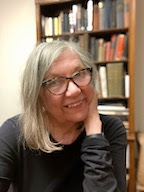
Sheila Packa Poetry Blog: A blog about poetry: figurative language, spirit, intertextual explorations, patterns, punctuation, forms, great writers, quotes, and journey notes. For updates, follow me on Bluesky https://bsky.app/profile/sheilapacka.com
Showing posts with label poetry book club. Show all posts
Showing posts with label poetry book club. Show all posts
In Duluth, since 2018, I have facilitated a book club for poetry at Zenith Books. The bookstore was kind enough to host us in between the stacks. In the past year, due to the pandemic, our book club moved online. Zenith Books still orders books for us, and they sell them to book club members at a 15% discount. Zenith Bookstore is a fantastic local bookstore, and they have continued to help the readers in Duluth get through the pandemic. You can order books online to be mailed or for curbside delivery.
The book club has been meeting for over two years. Lately we gather together on Zoom (contact me if you would like an invite). The discussion is wide-ranging. We discuss the topic or theme and also examine voice, metaphor, images, sound patterns, and forms. Members often do more research to learn biographical or other related information about the poets.
Our list of books (in the order that we read them):
Ocean Vuong: Night Sky with Exit Wounds Natalie Diaz: When My Brother Was an Aztec Natasha Tretheway: Native Guard Danez Smith: Don’t Call Us Dead Tracy K. Smith: Duende Joy Harjo: Conflict Resolution for Holy Beings Tom Sleigh: House of Fact, House of Ruin Jane Hirshfield: The Beauty Forrest Gander: Be With Ross Gay: Catalog of Unabashed Gratitude Ada Limon: The Carrying Maggie Nelson: Bluets Sharon Olds: Odes Hanif Abdurriq: A Fortune for Your Disaster Saeed Jones: Prelude to Bruise Sarah Ruhl: 44 Poems for You Farzana Marie: Load Poems Like Guns: Women’s Poetry from Herat Afghanistan Sun Yung Shin: Unbearable Splendor Andrea Jenkins: The T Is Not Silent Robin Coste Lewis: Voyage of the Sable Venus Marilyn Chin: A Portrait of the Self as Nation Louise Glück: Poems 1962-2012 Jericho Brown: The Tradition Tomas Tranströmer: The Great Enigma. Lorine Niedecker: Granite Pail or Selected Poems
The Poetry Book Club at Zenith Bookstore meets on the second Wednesday of each month at 5:30 pm. On July 10, 2019, the selection is Tom Sleigh's House of Fact, House of Ruin.
Book Review:
Poetry is always political. Even if it is not about a political event, the political is expressed in the word choice, perspective, and land that it arises from. Once I attended a workshop taught by the Irish poet Eavan Boland. She says land is always inseparable from politics. But she also criticized poets who use political events, especially traumatic events such as the Holocaust, as a type of "political tourism." She underlined poetry's ability to recreate a moment, and she cautioned poets against re-traumatizing others. I knew what she meant by this.
Tom Sleigh's poetry reflects his journeys in places of violent combat. His latest book House of Fact, House of Ruin was published in 2018 by Graywolf Press with a companion book of essays, The Land Between Two Rivers: Writing in an Age of Refugees. His work is the effort to witness and bring the hard facts into literature. In Iraq, Lebanon, Mogadishu, Dadaab (a large refugee camp) and other places, he has met and talked with military personnel, Red Cross workers, and civilians. His work is also a poetry of witness but also of form (images, figurative language, and sound patterns). Many of these poems are sonnet forms with a subtler rhyme. It's effective. It honors the tradition while at the same time playing with sound in way that suits contemporary times. This attention to craft and his sensitivity create very good poems. He says:
political emotions are always complex, and deeply troubled. So the accurate expression of mixed emotion seems to me to be at the core of the poetry I most care about. Yeats said it in a somewhat more rhetorical way when he wrote that the purpose of art was to hold reality and justice in a single thought.
It would be wrong for poetry to ignore the reality of our world: the wars, the suffering, and the stories of survival. He describes the influence of the poet Bashō on his own work. Sleigh's earlier book uses the haibun form, and this book reflects the "color." The journey was to Iraq. The titles are direct but when it comes to the content, the poems have a similar imagistic, evocative, and haunting quality.
In the 1600s, Japanese poet Bashō (1600s) wrote Narrow Road to the Interior:
The moon and sun are eternal travelers. Even the years wander on. A lifetime adrift in a boat or in old age leading a tired horse into the years, every day is a journey, and the journey itself is home.
The text collects the images and observations Bashō found in his wanderings. The journey was through the landscape of Japan, and it was also an inner journey. As a scholar of Buddha and Confucius (among others), he created a literary art that held the vivid images of place, detachment from things, and passing of all things including the self. An important term is the Japanese concept of aware. Ivan Morris describes it as "the pathos inherent in the beauty of the other world, a beauty that is inexorably fated to disappear together with the observer." Also important were the "pillow word" (referring to the double entendre or word that evokes many meanings) and the "pivot." This turn is very important in haiku. It creates an ambiguity that deepens the meaning.
In an essay on Poets.org, poet Aimee Nezhukumatathil writes:
the form is thinking of haibun as highly focused testimony or recollection of a journey composed of a prose poem and ending with a meaningful murmur of sorts: a haiku. The result is a very elegant block of text with the haiku serving as a tiny bowl or stand for the prose poem.
She goes on to list the important elements of the haibun form
detachment from the self (no personal pronouns)
concentrated use of sensory detail
the use of a seasonal word or one that alludes to the season
a turn or pivot in the 3rd line of the prose section
haiku at the end with approximately the 5-7-5 syllables in the three lines.
Tom Sleigh writes about the importance of Bashō's work to his own:
…this quality that I find most galvanizing in Bashō’s work—not the Buddhist trappings, or the delicate melancholy, or his sensitivity to flowers and mist; but his submersion of self in the world as he finds it, a world that is always every moment fighting to restore its equilibrium, but only as a way of losing it.
I like Sleigh's work here in this book. Some of his early poems are not among my favorites, as they feel more cocky and less attentive. This is not the case here. Even when Sleigh is not writing haibun, he is using the elements of this form. It feels right.
The poetry book club meets at Zenith Books June 12 at 5:30 pm. Come and join us!
Book Review
The opening poem in Danez Smith's Don't Call Us Dead sings with music. Figurative language vaults the images into myth. His subject goes right to the heart. There's grief and rage and America right now: violence, race, HIV, gay men. Danez confronts and is confronted by fear, and he uses it for new vision. This is done with a mastery of language and metaphor.
summer, somewhere
somewhere, a sun. below, boys brown
as rye play the dozens & ball, jump
in the air & stay there. boys become new
moons, gum-dark on all sides, beg bruise
-blue water to fly, as least tide, at least
spit back a father or two….”
Poetry is physical and connected to the breath. In language, adept use of sound creates powerful and moving effects. In contemporary poetry, the music and rhythm has more movement and freedom. In Danez's work, an examination of this short excerpt reveals a very interesting rhythm that surprises and pleases the reader.
Traditional ways of analyzing poetic lines involve 'scansion,' or scanning the lines to look at the accented syllables. In poetry, each unit of metric rhythm is called a "foot." This poem has a wonderful combination of rhythms. Iambic is a heart beat rhythm ( x / ) with the accented syllable second. Trochaic is the opposite with the accented syllable first. Dactyl and spondee are the names of three syllable feet (dactyl: (/ x x) and spondee (x x /). However, meter is not the only determination of sound. The actual rhythm might de-emphasize metrics or emphasize some syllables more.
The language choices are superb: "a trapgod hymn (what a first breath!)" and "sprinkler dancer, i can't tell if I'm crying / or i'm the sky..." Curious, those interesting shifts from the lower case to the upper case pronoun i/I. "...fingers always/ dusted cheeto gold..." The poems vibrate with energy. Images of birth are combined with death. Images of sex are combined with death. Images of death are combined with re-birth. Danez skillfully uses vernacular and language of myth: "if we dream the old world/ we wake up hands up...."
...say the word
I can make any black boy a savior//
make him a flock of ravens
his body burst into ebon seraphs.
Danez takes these images and moves them ever higher from metaphor to myth: "the forest is a flock of boys/ who never got to grow up // blooming into forever / afros like maple crowns." And once again, a capitalized letter creates a shift in meaning because the word goes from a noun to a name: " "...watch/ Forest run in the rain, branches // melting into paper-soft curls, duck under the mountain for shelter. watch// the Mountain & Forest playing..."
If you are reading this book, are you uncomfortable? If you are white, you should be. If you are straight, you should be. This mirror shows us America. Danez's poems reveal a person who is willing to be vulnerable. Gay sex is visceral in this collection. The poet has been diagnosed with HIV. He's talking about blood. Blood connects to racial violence in America. He's created a documentation of several incidents of racial violence, lynching and death at the hands of the police. "crown" is a crown sonnet, a series of sonnets that are linked by a repeated image in last line and first lines. The title also evokes the first moment of birth, crowning.
The striking thing for me about his collection is the claiming/ naming/ breaking through. The last poems are a prayer and a dream about every black person is standing by the ocean. The last lines: "& then one woman, skin dark as all of us / walks to the water's lip, shouts Emmett, spits// & surely, a boy begins/ crawling his way to shore"
The water's lip certainly connects the ocean to the body. Spit, another body fluid, and bit of magic that brings us around from fear of HIV to intimacy. This boy might be Emmett Till, bringing us around from violence to regeneration. Or this boy might be another, a swimmer and a survivor. He is being born, crowning, about to emerge.
Are you available on the second Wednesdays of the month at 5:30 pm? Have you ever wanted to talk about the amazing book of poems you've just read? Welcome to the Poetry Book Club at Zenith Books in Duluth, Minnesota!
Each month, we'll feature a book of poetry. In January, the book will be Ocean Vuong's Night Sky with Exit Wounds. In February, it will be My Brother Was an Aztec by Natalie Diaz. The book club will be facilitated by former Duluth Poet Laureate, Sheila Packa.
The following months, I hope to select really good poetry books via recommendations by the participants. Maybe you're a writer or maybe just curious. This book club is for everybody who loves to read poetry. Order your book club book with Zenith Bookstore for 15% discount.
At the meetings, we'll talk about metaphors, sound patterns, and anything else that might happen to come up in conversation about poems. We won't have a rigid structure, but I will facilitate the conversation. So pick up a book, read some of it or all of it, and come and talk about your impressions!
Not used to the idea of a poetry book club? We can talk about the content of the poems and the form. The following things are common to all poetry:
Sound patterns: repeated words or phrases, alliteration, repeated vowel sounds (assonance), rhyme, meter, beat. Poetry is connected to the breath. Poets use spacing and punctuation to help the reader say it aloud.
Visual patterns: some poets create a visual pattern on the page. There are line breaks (usually the line ends on an important word) and stanza breaks (stanzas are similar to paragraphs)
Figurative language: images are important (nouns and verbs predominate), poems often use metaphor (one thing used to describe something else), personification (giving human attributes to things or animals), metonymy (using just a portion of something to name something else -- example, hands might be used to refer to workers, crown might be used to refer to king or queen)
Form: Poems might have a traditional meter or form, or the poet might create a unique pattern or form. Observations are welcome about the length of the poem, about stanzas, lines, line breaks, enjambment (a sentence that runs over a couple of lines) and other elements of the physical form. These are a few of the many different types: elegy (like eulogy), love poem, ode (celebration of things or people or places), aubade (morning poem), ekphrastic poem (written to or for a piece of visual art), sonnet, villanelle, etc.
Talking about a poem generally always leads to discoveries and a deeper appreciation. Sometimes it might lead to you writing some poems of your own. I look forward to our conversations.