September 16, 2022
What Use is Poetry?
July 29, 2022
Upcoming Readings - Fall 2022
October 19, 2022, Wednesday, 6:00 pm. Poet Laureate Reading at the University of Minnesota Duluth, Kathryn A. Martin Library, featuring Sheila Packa and Dani Pieratos. Ellie Schoenfeld and Tina Higgins Wussow.
October 27, 2022, Thursday, 7:00 pm, Quaker Meeting House, Duluth, Minnesota. Bart Sutter and Sheila Packa poetry reading. Piano by David From. Reception to follow.
November 6, 2022, Sunday, 3:00 pm. Nordic Center, Lake Avenue, Duluth, MN. Book launch! Sheila Packa reading from her new book, Surface Displacements, along with an art installation. Art talk: Confluences: Writing, Composing, Making Art from Art by poet Sheila Packa, composers Sara Pajunen, Wendy Durrwachter & Kathy McTavish, & quilt artist Leslie Hughes.
November 9, 2022, Wednesday, 5:00 pm, Fond du Lac Tribal and Community College, Cloquet, Minnesota. Sheila Packa, reading from new book, Surface Displacements. Reception at 4:30 pm. This event at 5 pm can also be viewed live on Zoom. Here is the link: https://minnstate.zoom.us/j/4618587742
May 22, 2022
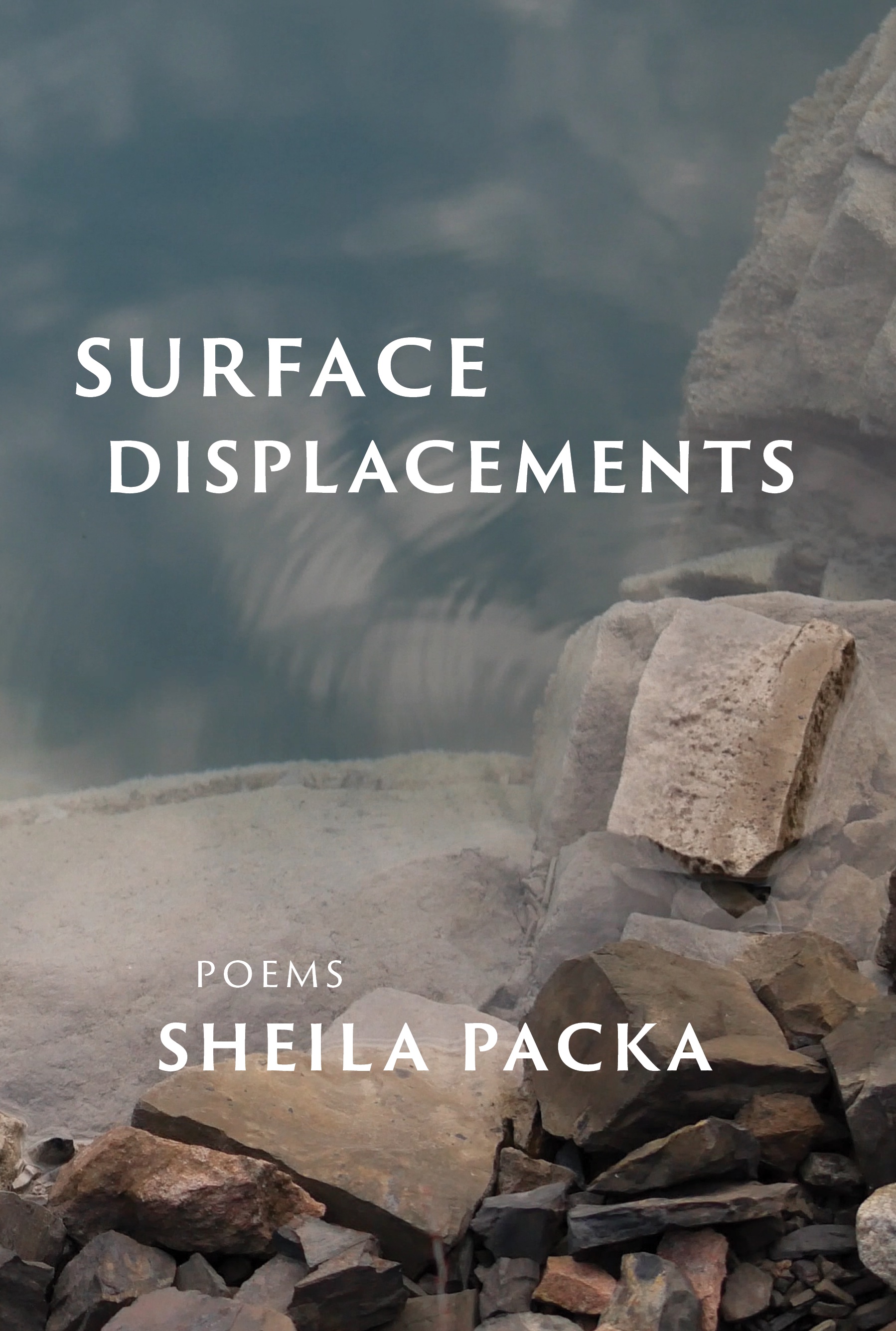
It's Here! Surface Displacements
The cover is an aerial image by Sara Pajunen, and the book design by Kathy McTavish.
Available through any bookstore or at https://www.wildwoodriver.com/
Praise for the book
“In Surface Displacements, the spirit of the ancient Finnish shamans breathes again. Sheila Packa’s best early poems recalled her youth on Minnesota’s Iron Range, growing up in households where Finnish was still spoken, where the immigrant towns were gritty working-class, in a landscape of mine pits, forests, and water. That environment remains her fundamental source, though now everything has changed, changed utterly, as Packa has learned, with increasing confidence, to incorporate history, science, and myth, even as her language has grown more musical, her poems more spiritual. Like the old shamans, she has become a shapeshifter, able — through the dreamy trance of poetry —to speak in the voice of a snail, rivers and lakes, an entire landscape and its people.” —Bart Sutter, author of So Surprised to Find You Here
“There is a beckoning, a teaching, a singing and lamenting in Sheila Packa’s Surface Displacements. In rivers, headwaters, displacement and the otherworld we are given ways of navigating earth’s trauma in the sink and rise of all that is broken, all that survives. Whispers, dialogues, and the power of forgotten language are forged in the stellar poetic title poem that speaks of both beauty and loss. This is an important book of place, that calls out truth, journeys into landscape, history and the natural world. Ancestry runs through this book as challenge and praise, a way of naming that offers 'the tongue with the old root.' Packa dives into the body of language and voices the body of the earth with skill and relish. 'To speak is to mend' is an invitation to us all in this intimate and compassionate calling out of the elegant and fragile wonders of this world.” —Diane Jarvenpa, author of The Way She Told Her Story and The Tender Wild Things
“Surface Displacements is a Lake Superior epic, an Iron Range chronicle, a Northland saga in which the human psyche merges with rock and water. This book has a heartbeat, and its rhythms are those of Great Lake seiches and flooded open pit mine waves. This poet’s practice is not only one of noticing but also of becoming, as self and landscape merge. Or perhaps it’s more accurate to say that humanity and geography have always been one, and Packa’s words remind us of what we know in our bones: that life is movement, displacement, and constant 'shift(s) from state to state'; and also that we are connected to a core of belonging forged from earth and spirit. These gorgeous poems are incantations of legacy, deep roots, disturbance, destruction, flight, and transformation.” —Julie Gard, author of Home Studies
"Through the art of attention, Sheila Packa elevates the landscape of northern Minnesota to the holy. Each poem is a room rich with texture, imagery, and sound that resonates long after one puts the verses down. This is a book to simultaneously lose oneself and find oneself in." —Darci Schummer, author of Six Months in the Midwest
Sheila Packa was a fiscal year 2022 recipient of a Creative Support for Individuals grant from the Minnesota State Arts Board. This activity was made possible by the voters of Minnesota through a grant from the Minnesota State Arts Board, thanks to a legislative appropriation from the arts and cultural heritage fund. She was also a fiscal year 2020 recipient of an Artist Initiative Grant from the Minnesota State Arts Board. This activity is made possible by the voters of Minnesota through a grant from the Minnesota State Arts Board, thanks to a legislative appropriation by the Minnesota State Legislature; and by a grant from the National Endowment for the Arts.
November 19, 2015
And We Who Move Away: Nelly Sachs
peering through blue curtains
between his antlers bears
a sun-egg hatched pale─
October 16, 2015
Earth Body: The Art of Ana Mendieta
Covered by Time and History: The films of Ana Mendieta is showing at the Katherine Nash Gallery in Minneapolis. In four rooms of the gallery, the installation of several short films (in continuous looping) immerses the viewer in her art.
Mendieta called her practice Earth Body. It was a fusion of body art and earth art. In the 1970s, an art critic identified her work as being feminist and goddess like. Mendieta did not agree with this analysis, and she made some changes to prevent further assumptions. Her work does have a spiritual quality, but she was also exploring her culture, immigration, and violence toward women.
Mendieta imprinted herself on the earth. She did not bury herself, but maintained the abstract figure /outline on the surface. This female earth form degraded as it was exposed to the elements. Often the form was filled with fire or water. Her performance art she documented by video and photographs. I found the sculpture and her earth works to suggest a vulva-like shape. She also had film and images of herself marked with animal blood (and a sidewalk, and a wall). This series was triggered by the murder of a female student, to acknowledge and address the violence. Some films are of her holding a decapitated chicken, wings flapping. It's visceral and powerful work.
In her film, she explained that she used the earth to express her connection with nature. This connection began as a child in Cuba, and later as an immigrant in the US, she found that her practice helped maintain her roots and connection with her culture.
Adriana Herrera Téllez, in Arte Al DĂa, has an excellent article about Mendieta's work that provides insight into her practice. Mendieta has been described by Olga Viso (currently at the Walker Art Center) as "inventive and iconoclastic." Téllez believes Mendieta has influenced several other artists, including Marina Abramovic, yet Mendieta has not received the attention she deserves. Téllez describes her artwork in this way:
experimental art, capable of fusing aspects of primitive and conceptual art, mythical traditions and ecology, the land and performance, the non-territorial concern for violence against the female gender and the transcultural, displaced identities and the universal archetype.Amanda Boetzkes says, “the artist does not only attempt to create a space in which the earth receives her body, but through her way of withdrawing it, provides a surface on which the elementary may appear the silueta fills with water, combustion or is blown apart and illuminates the face of the earth.”
Ana Mendieta's work has been a source of inspiration for me. Here is a poem that I wrote to pay homage to her.
Spilled
for Ana Mendieta
So light
the trembling of leaves
in the water’s mirror
shadow of your contour
shoulder on shore
line of tree your spine.
So dark
the stones depth, cold hip
I trace the root
in the earth’s script
where you’ve cast runes
written yourself in blood
or feathers spilled and mud
taken up with gunpowder
returned what never returns
to the continent or your hands.
Memory of fire that cast its spark
into the vast body giving birth
and reaching
the branch that breaks
beneath the feet,
drew yourself upon a leaf
falling
from a tree or upper story.
Lost with certainty
the perfect execution—
self was never the answer
only earth.
c2012 Sheila Packa in Cloud Birds, Wildwood River Press, 2012.
Sources:
Boetzkes, Amanda. The Ethics of Earth Art, University of Minnesota Press, 2010. P. 163
Téllez, Adriana Herrera. “Ana Mendieta Revisited.” November 30, 2010. Retrieved 15 October 2015. Arte Al DĂa / International / Contents / Artists / Ana Mendieta http://www.artealdia.com/International/Contents/Artists/Ana_Mendieta
January 24, 2015
Sara Pajunen - Teija Niku - Aallotar
I enjoyed reading poetry with Aallotar recently, at a house concert. We share a love of Finnish culture and a penchant for research. Our work has remarkable confluences. Here's a sample of Sarah's exploration into the experience of Finnish immigrants. She and Teija provide a haunting and beautiful music. The video is 14 minutes - (archives from the Immigration History Research Center Archives, University of Minnesota0
http://www.sarapajunen.com/laatikko/
touring the Midwest January and February 2015
see dates/ places: http://www.aallotarmusic.com/shows.html#!shows/cihc
December 17, 2014
KAXE Radio: On the Beat
Thanks to Steve Downing, I'm On the Beat @ KAXE Radio in Grand Rapids, MN. Here's a poem from Night Train Red Dust. "Old Music"
http://kaxe.org/Audiobox/Beat/KAXE_Beat_2014_12_11_SPacka_OldMusic.mp3