June 29, 2019

Prose Poem or Microfiction?

It doesn't matter, does it, whether a piece of writing is labeled a prose poem or a flash or microfiction? Is it the same, apples to apples?  Or is it apples to oranges?

Russell Edson said, “A good prose poem is a statement that seeks sanity whilst its author teeters on the edge of the abyss.”  

As for me, I haven't yet decided. Is there a difference in compression? in the predominance of figurative language? in the music of the language?  Yes. No. 

No end words: 

Poetry yields as many end words as there are lines in the poem. End words are particularly important in poetry. They are usually very important: nouns or verbs. They can be used skillfully to develop enjambment and to increase meaning through a line break and ambiguity. Prose poems have but one end word. This may allow a poet to give the emphasis to the word that ends the prose poem. In microfiction or flash fiction, not much attention is paid to the end word of a paragraph.  Maybe not enough attention.  

Stanzas or paragraphs

Stanzas are poetry's paragraphs. Turns occur between stanzas. Leaps can be made in time and space. In prose, there are transitions, associations, and leaps but the paragraph might be barely noticed. It is easy to conclude that form is less important in prose. One still can use music, rhyme, rhythm, and sound patterns. They are "buried' inside the paragraph.  

Form 

The form of a poem might be considered a container. Poetic forms have history, patterns, associations: sonnets, villanelles, sestinas, quatrains, etc.  Prose forms are more loose and flexible. A poem or a prose might be a letter, a list, a story. Content is perhaps more important in prose. The intention might be to entertain, investigate, or illuminate. 

Audience

Perhaps the answer resides in which audience one wants. Naming the genre or using a genre form sets up an expectation. In prose, genres are sci-fi, fantasy, murder mystery, romance, western, or nonfiction. Poetry is a genre.  Prose poetry might be blend of genres, a hybrid form. Of course writers of both poetry and prose explore and widen the boundaries.  There is plenty of genre-bending. 

Definitions:

According the Poetry Foundation, "A prose composition that, while not broken into verse lines, demonstrates other traits such as symbols, metaphors, and other figures of speech common to poetry. See the prose poem,"Information" by David Ignatow: https://www.poetryfoundation.org/poems/43416/information-56d222285400c

Perrazo and Dal wrote an academic paper examining the differences and similarities between these two forms. They identify criteria: brevity, fragments, ambiguity, and pivots. Either the prose poem or the flash fiction (or microfiction) could be narrative. The difference might be that the microfiction suggests a larger story or is a pivotal moment in a larger story. 

Writers:

Amy Hempel has written brief fiction.  "Sing To It," in the book of that title, is less than half a page.  Of her writing, Amy Hempel said, “I leave a lot out when I tell the truth. The same when I write a story." In a review of Hempel's work, Ruth Franklin said, "For Hempel, a story often takes place not at the moment of crisis but in its aftermath." Hempel recalls a writing class with Gordon Lish.  For his students’ first assignment, Gordon Lish instructed them to write about their worst secret: the thing they had done that, as he put it, “dismantles your own sense of yourself.”  

Lydia Davis is a master of short fictions. "Letter to a Funeral Parlor" is simply that, a brief and amusing (and poignant) demand for an explanation of the use of the word "cremains."  Davis cites the influence of Russell Edson. She is interested in stories, and she is interested in etymology. In her work, they often come together in ways that are comic and profound.

Diane Williams writes very brief narratives. They are elliptical, associational, and sometimes even musical.  See https://lithub.com/bang-bang-on-the-stair/ and https://www.vice.com/en_us/article/mvx79p/five-very-short-stories-0000667-v22n6, plus http://www.thewhitereview.org/feature/diane-williams-two-stories-and-an-interview/

Peter Orner dislikes the term flash fiction. This form is not new, he says. "How many lines are in the story of Adam and Eve?" he asks. Well, I looked it up. Chapter 3 of Genesis is less than 700 words. Electric Literature has samples of flash fiction.  https://electricliterature.com/7-flash-fiction-stories-that-are-worth-a-tiny-amount-of-your-time/

Nick Ripatrozone wrote an essay examining this question. He says, "...genres are not spouses. Monogamy has no place here: the writer should–and must–be flexible to genre. Genre, mode, form: these considerations are contextual and situational." 


June 12, 2019

Danez Smith: Crowning


The poetry book club meets at Zenith Books June 12 at 5:30 pm.  Come and join us! 

Book Review

The opening poem in Danez Smith's Don't Call Us Dead sings with music. Figurative language vaults the images into myth.  His subject goes right to the heart. There's grief and rage and America right now: violence, race, HIV, gay men. Danez confronts and is confronted by fear, and he uses it for new vision. This is done with a mastery of language and metaphor.

summer, somewhere

somewhere, a sun. below, boys brown
as rye play the dozens & ball, jump

in the air & stay there. boys become new
moons, gum-dark on all sides, beg bruise

-blue water to fly, as least tide, at least
spit back a father or two….”


Poetry is physical and connected to the breath.  In language, adept use of sound creates powerful and moving effects.  In contemporary poetry, the music and rhythm has more movement and freedom.  In Danez's work, an examination of this short excerpt reveals a very interesting rhythm that surprises and pleases the reader.

Traditional ways of analyzing poetic lines involve 'scansion,' or scanning the lines to look at the accented syllables.  In poetry, each unit of metric rhythm is called a "foot." This poem has a wonderful combination of rhythms.  Iambic is a heart beat rhythm ( x / ) with the accented syllable second. Trochaic is the opposite with the accented syllable first.  Dactyl and spondee are the names of three syllable feet (dactyl: (/ x x) and spondee (x x /). However, meter is not the only determination of sound. The actual rhythm might de-emphasize metrics or emphasize some syllables more. 

The language choices are superb: "a trapgod hymn (what a first breath!)" and "sprinkler dancer, i can't tell if I'm crying / or i'm the sky..."  Curious, those interesting shifts from the lower case to the upper case pronoun i/I.  "...fingers always/ dusted cheeto gold..."  The poems vibrate with energy.  Images of birth are combined with death. Images of sex are combined with death.  Images of death are combined with re-birth.  Danez skillfully uses vernacular and language of myth: "if we dream the old world/ we wake up hands up...."

              ...say the word
I can make any black boy a savior//
make him a flock of ravens
his body burst into ebon seraphs.

Danez takes these images and moves them ever higher from metaphor to myth:  "the forest is a flock of boys/ who never got to grow up // blooming into forever / afros like maple crowns."   And once again, a capitalized letter creates a shift in meaning because the word goes from a noun to a name: "  "...watch/ Forest run in the rain, branches // melting into paper-soft curls, duck under the mountain for shelter.  watch// the Mountain & Forest playing..."

If you are reading this book, are you uncomfortable? If you are white, you should be. If you are straight, you should be. This mirror shows us America. Danez's poems reveal a person who is willing to be vulnerable.  Gay sex is visceral in this collection. The poet has been diagnosed with HIV. He's talking about blood.  Blood connects to racial violence in America. He's created a documentation of several incidents of racial violence, lynching and death at the hands of the police.   "crown" is a crown sonnet, a series of sonnets that are linked by a repeated image in last line and first lines. The title also evokes the first moment of birth, crowning. 

The striking thing for me about his collection is the claiming/ naming/ breaking through. The last poems are a prayer and a dream about every black person is standing by the ocean.  The last lines:  "& then one woman, skin dark as all of us / walks to the water's lip, shouts Emmett, spits// & surely, a boy begins/ crawling his way to shore"

The water's lip certainly connects the ocean to the body. Spit, another body fluid, and bit of magic that brings us around from fear of HIV to intimacy. This boy might be Emmett Till, bringing us around from violence to regeneration.  Or this boy might be another, a swimmer and a survivor.  He is being born, crowning, about to emerge.

---

Read "a poem where I be and you just might" and an excerpt of Danez's thoughts about this poem:
 https://www.poetrysociety.org/psa/poetry/crossroads/own_words/Danez_Smith/

Granta Magazine:  "crown" https://granta.com/crown-smith/

Publisher, Graywolf Press: https://www.graywolfpress.org/books/dont-call-us-dead


May 22, 2019

Walt Whitman at 200


Come join us! Friday, May 31 at 7 pm.  “Walt Whitman at 200: A Birthday Party with Poetry Readings, Presentations, and Cake” will take place at the Hartley Nature Center, 3001 Woodland Ave., Duluth. 

The event will feature readings by Duluth Poets Laureate Bart Sutter, Deborah Cooper, Sheila Packa, Ellie Schoenfeld, and Gary Boelhower; presentations by Mara Hart, Professor John D. Schwetman, and Professor Chris Johnson; and book sales of recently published anthologies by Holy Cow! Press.


May 7, 2019

Writing about Place


Meena Alexander said, "Poetry and place—if poetry is the music of survival, place is the instrument on which that music is played, the gourd, the strings, the fret."

In poetry and prose, place is critically important. In her book "On Writing," Eudora Welty wrote:
Place, to the writer at work, is seen in a frame. Not an empty frame, a brimming one. Point of view is a sort of burning-glass, a product of personal experience and time; it is burnished with feelings and sensibilities, charged from moment to moment with the sun-points of imagination. It is an instrument — one of intensification; it acts, it behaves, it is temperamental. … The writer must accurately choose, combine, superimpose upon, blot out, shake up, alter the outside world for one absolute purpose, the good of his story. To do this, he is always seeing double, two pictures at once in his frame, his and the world’s, a fact that he constantly comprehends; and he works best in a state of constant and subtle and unfooled reference between the two. It is his clear intention — his passion, I should say — to make the reader see only one of the pictures — the author’s — under the pleasing illusion that it is the world’s; this enormity is the accomplishment of a good story. I think it likely that at the moment of the writer’s highest awareness of, and responsiveness to, the “real” world, his imagination’s choice (and miles away it may be from actuality) comes closest to being infallible for his purpose. For the spirit of things is what is sought. No blur of inexactness, no cloud of vagueness, is allowable in good writing; from the first seeing to the last putting down, there must be steady lucidity and uncompromise of purpose.

In an essay poet Meena Alexander wrote:
While poetry is bound to the sensorium, to the sensual powers of bodily being, to memory that draws its power from feelings heightened by the senses, it is also bound to place. It is in place that we locate ourselves, mark ourselves in relation with others; it is in place that we survive. But what becomes of the past when place is torn away, when the sensorium is radically displaced, and when exile or dislocation marks out the limits of existence?

April 30, 2019

Poetry Events

Poetry Events

May 20, 2019  (Monday) 7:00 pm - 9:00 pm - Celebrating the recent publication of "Undocumented: Great Lakes Poets Laureate on Social Justice" edited by Ron Riekki and Andrea Scarpino at Content Bookstore, Northfield, MN with 5 Poet Laureate recipients: James Armstrong, Emilio DeGrazia, Rob Hardy, Ken McCullough, and Sheila Packa.  For information about the book, see http://msupress.org/books/book/?id=50-1D0-4581#.XMiJYpNKgdV

May 31, 2019 (Fri) 7:00 pm – 9:00 pm – Organized by Duluth Poet Laureate Gary Boelhower, the event “Walt Whitman at 200: A Birthday Party with Poetry Readings, Presentations, and Cake” will feature readings by Duluth Poets Laureate Bart Sutter, Deborah Cooper, Sheila Packa, Ellie Schoenfeld, and Gary Boelhower; presentations by Mara Hart, Professors John D. Schwetman, and Chris Johnson; and book sales of recently published anthologies. The event is free and open to the public and refreshments will be served. For additional information, please contact Gary Boelhower, gboelhower@msn.com. Hartley Nature Center, 3001 Woodland Avenue, Duluth, MN 55803.


Poetry Book Club @ Zenith Books

May 8 (Wed) 5:30 pm – 7:00 pm – In May, we are discussing “The Beauty” by Jane Hirshfield. Zenith Bookstore, 318 North Central Avenue, Duluth, MN 55807.


June 12 (Wed) 5:30 pm – 7:00 pm –  In June, we are discussing Danez Smith's "Don't Call Us Dead," a finalist for the 2017 National Book Award. 


April 27, 2019

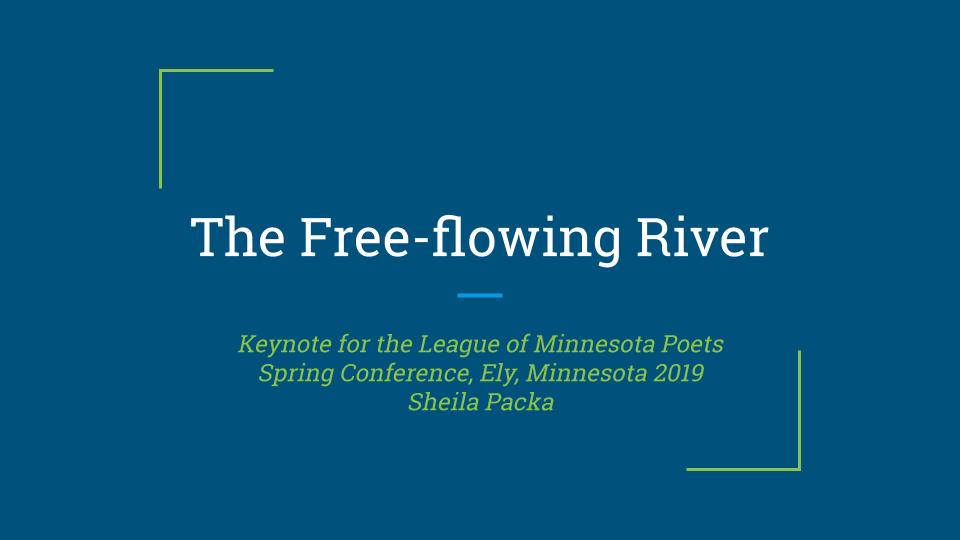
A Free-flowing River: Thoughts About Poetry


To see the slides, click on this link:  http://www.sheilapacka.com/ely2019.pdf

April 27, 2019 Keynote Address for the League of Minnesota Poets Spring Conference in Ely, Minnesota.

This keynote presents my experience of a northern watershed and an intertextual exploration of poetry. This examines ideas of flow, rhapsody, turns, landscape, headwater, time, erosions, opposing forces, tributaries, the body, permeability, mosaics, and it includes Works Cited.

April 22, 2019

The Muse


"When I Met My Muse"
by William Stafford

I glanced at her and took my glasses
off–they were still singing. They buzzed
like a locust on the coffee table and then
ceased. Her voice belled forth, and the
sunlight bent. I felt the ceiling arch, and
knew that nails up there took a new grip
on whatever they touched. “I am your own
way of looking at things,” she said. “When
you allow me to live with you, every
glance at the world around you will be
a sort of salvation.” And I took her hand.

I'm especially fond of Stafford's poem because it emphasizes the muse is connected to one's own set of perceptions. "Writer's voice" is the unique set of perceptions, attentions, obsessions, and experience of the writer. It reflects his or her culture, words, habits, and landscape. A writer needs a muse. Each writer has a unique experience and image of his or her source of inspiration.

April 12, 2019

Wilderness and Mineral Landscapes


Lately, musician Sara Pajunen has been composing Mine Songs: Sounding an Altered Landscape. https://minesongsmusic.com/  She has been recording sound and video in areas near mining operations and at harbors, and she uses this collected sound in her violin compositions. It's beautiful work. 

I have a poem published at Cortland Review, "Boundary Waters."  In this excerpt, I allude to the extraction of minerals in the northern Minnesota landscape.

a tail flick of a fin 
among the sunken 
shoulders
in a vein of ore. 
To take from another body
is a question
answered by loon...

There is a tension here between the environmental quality and economic development in the form of taconite and iron mines. In order to sustain our lives, there is a balance we need to achieve between economics and environment.Read the entire poem at http://www.cortlandreview.com/issue/60/packa.php

Horses: A Lyric Essay

Entropy Magazine published my lyric essay, "Horses."  This was written for Sibelius' Symphony #2.

The series "Variations on a Theme" seeks to examine the intersection between music and literary works.

"Music can hold enormous power in memories and experiences, transporting us instantly to an age, location, or person. What sonic joys, mysteries, disbelief, and clarity have you experienced?"

Read the essay at Entropy's website:

https://entropymag.org/variations-on-a-theme-horses/

April 1, 2019

Donald Hall: Goatfoot, Milktongue, and Twinbird


In the essay, "Goatfoot, Milktongue, and Twinbird: Interviews, Essays and Notes" Donald Hall considers the psychic origins of poetry.

This essay captures what feels true.  Donald Hall believed poetry had root in vatic expression, coming from God or the divine. In addition, he considers the experience that is preverbal as a major source of poetry, saying: "The mouth pleasure, the muscle pleasure, the pleasure of match-unmatch.”  Milktongue refers to the five senses, the infant nursing at the breast with milk in his or her mouth.  Goatfoot refers to muscle pleasure, like the rhythms of nursery rhymes, games and happy dances. Twinbird is the infant's discovery of his or her hands. Like birds, they are in the air. Initially, they seem independent but gradually a baby understands the hands are dependent and respond to his or her will. Also a delight grows when a child sees the mirror image, the match-unmatch of the hands. The words goatfoot, milktongue and twinbird contain both image and rhythm (dactyl).

In the following poem by Hall, one can trace these three: mouth pleasure, muscle pleasure and match/unmatch.


Gold

Pale gold of the walls, gold
of the centers of daisies, yellow roses
pressing from a clear bowl. All day
we lay on the bed, my hand
stroking the deep
gold of your thighs and your back.
We slept and woke
entering the golden room together,
lay down in it breathing
quickly, then
slowly again,
caressing and dozing, your hand sleepily
touching my hair now.

We made in those days
tiny identical rooms inside our bodies
which the men who uncover our graves
will find in a thousand years,
shining and whole.


Hall also once said, "Poetry begins in elegy."  See his essay about elegy here: https://www.newyorker.com/books/page-turner/the-poetry-of-death

To see his entire book of essays, Goatfoot, Milktongue, and Twinbird: Interviews, Essays and Notes (digitally archived): https://hdl.handle.net/2027/mdp.39015002132382

See the text of "Gold" by Donald Hall: https://www.poets.org/poetsorg/poem/gold