Showing posts with label violence. Show all posts

March 13, 2019

Trethewey's Native Guard


The Poetry Book Club @ Zenith Books meets today, March 13 at 5:30 pm to discuss Natasha Tretheway's Native Guard.  In 2007, this book won a Pulitzer Prize. 


Myth is central to this book of poems, history is central, love and violence is central. Walt Whitman's words do well to summarize the poems of Native Guard: "Quick Mettle, Rich Blood, Impulse and Love, Good and Evil."

In interviews, Trethewey has spoken about feeling "ghosts everywhere around you." This book pays homage to her mother (murdered by her husband) and the black soldiers in the Union Army during the Civil War. It's a spare volume of poems that explores the contradictions of the South, the contradictions of marriage, and the contradictions of military service to the country.

Section I is about her mother. It begins with a poem, "Southern Crescent." A story embarks in this first poem, and it's a fitting entrance to the story. The mother is about to board the Crescent, the train, a fixture in the South, prided itself on excellent service. Two journey begin but are interrupted: the first, her mother going to meet her biological father but the connection is never made. He is not at the destination. In the second, the train derails and mother/daughter miss the connection.


The second poem of the collection is like the central integument of the book,"Genus Narcissus," The inscription by Robert Herrick emphasizes the ephemeral daffodils. The poem foreshadows the murder:


...I knew nothing

of Narcissus or the daffodils' short spring -- 
how they'd dry like graveside flowers, rustling
when the wind blew -- a whisper, treacherous,
from the sill. Be taken with yourself, 
they said to me; Die early, to my mother.
This poem is an important image for the book.  It evokes the myth of Narcissus and Echo that was written in Ovid's Metamorphosis.  Echo began as a talking nymph with magnificent voice and song.  In retaliation for a lie, Juno (Jupiter's wife) curses her by making her able to only finish a sentence not started, and unable to say anything on her own. She falls in love with Narcissus, and she follows him, echoing his words.  

Trethewey's connection between Echo and her mother is interesting. Women who are victims of domestic abuse do seem to lose their voice and song. Many do end up echoing the words of their abusers.   


Narcissus, a beautiful boy, was hunting when Echo saw him.  He rejects her. She prays to Venus of this -- and Venus makes Echo disappear until she remains a voice heard by all.
At the stream, he falls in love with his own reflection and he wastes away with love for himself. In awhile his body is gone and in its place a narcissus flower, a pale flower that grows by river banks so that it can be reflected. 

Reflections occur in form as well as content. The poem titled "Myth" presents a perfect mirror as it carries lines forward and backward.  "Graveyard Blues" is a blues form. Ekphrastic poems reflect photographs and the painting of Winslow Homer. 

The narcissism of this boy might well gesture toward the narcissism and self-absorption of the young. The poem seems to indicate this.  But narcissism and self absorption is always characteristic of an abuser in a domestic relationship, in Trethewey's step-father. Only concerned with himself, he does not love his wife well. As a result, they are both destroyed.  

There is another ghost or shadow here as well. The visual artist and illustrator Laurence Housman wrote a poem "Narcissus" about World War I: 
The New Narcissus
by Laurence Housman 
While war through Flanders sweeps in flood,And death goes flaring by,
Above the steam and stench of blood
Spring larks are soaring high;
And in the pause you hear their song,
While underneath, at rest,
Amid those mounds of human wrong
The young lie in the nest.
Down-nodding to the pit of death
The daffodils are through,
And shake their petals full of breath
Above a breathless crew.
Blithely they quaff and cast away
Light from their golden eyes,
Where, blind to all the beams of day,
The new Narcissus lies:
Who, in that dark and dreadful hole
Beheld a vision blest,
Saw the desire of his young soul,
And drank, and there found rest.
Within those eyes, beyond our ken,
Shut fast from present use,
The vision waits. There lie the men
Who kept the Christmas Truce.
This poem, this image of Narcissus, perfectly brings us to the topic of the Civil War, Section II of Native Guard. The new Narcissus is a dead soldier. The vision of war is triumph, but the truth is actually destruction. This is a stunning sequence of poems that blends history and images. The notes in the back of the book illuminate these poems even more.  A crown sonnet is the gem inside these fine poems, and the story is worthy of becoming immortalized in these poems.  The black soldiers in Union blue uniforms have no statues or commemorative markers for the sacrifices they made. Facing racism within the Union Army, they are denied even the term "native" though they are born on the soil. Instead they are called Corps d' Africa.  Not only have they died, but they were denied, and in history, nearly been forgotten.

Section III of the book holds an inscription by Walt Whitman, "O magnet South, O glistening perfumed South, my South/ O quick mettle, rich blood, impulse and love! good and evil! / O all dear to me." In this section, Trethewey returns to the more contemporary history of the south. The poem "Miscegenation" about her white father and black mother's marriage, illegal at the time. In the poem she makes reference to Faulkner's Joe Christmas and the origin of her name, Natasha which in Russian means Christmas child. At the time of her birth, her father was reading War and Peace. By these images, contradictions, connections Trethewey has created a work of remarkable and enduring beauty. She is well deserving of the Pulitzer Prize.

October 16, 2015

Earth Body: The Art of Ana Mendieta


Covered by Time and History: The films of Ana Mendieta is showing at the Katherine Nash Gallery in Minneapolis. In four rooms of the gallery, the installation of several short films (in continuous looping) immerses the viewer in her art.

Mendieta called her practice Earth Body. It was a fusion of body art and earth art. In the 1970s, an art critic identified her work as being feminist and goddess like. Mendieta did not agree with this analysis, and she made some changes to prevent further assumptions. Her work does have a spiritual quality, but she was also exploring her culture, immigration, and violence toward women.

Mendieta imprinted herself on the earth. She did not bury herself, but maintained the abstract figure /outline on the surface. This female earth form degraded as it was exposed to the elements.  Often the form was filled with fire or water. Her performance art she documented by video and photographs. I found the sculpture and her earth works to suggest a vulva-like shape. She also had film and images of herself marked with animal blood (and a sidewalk, and a wall). This series was triggered by the murder of a female student, to acknowledge and address the violence. Some films are of her holding a decapitated chicken, wings flapping. It's visceral and powerful work.

In her film, she explained that she used the earth to express her connection with nature. This connection began as a child in Cuba, and later as an immigrant in the US, she found that her practice helped maintain her roots and connection with her culture.

Adriana Herrera Téllez, in Arte Al Día, has an excellent article about Mendieta's work that provides insight into her practice. Mendieta has been described by Olga Viso (currently at the Walker Art Center) as "inventive and iconoclastic."  Téllez believes Mendieta has influenced several other artists, including Marina Abramovic, yet Mendieta has not received the attention she deserves. Téllez describes her artwork in this way:
experimental art, capable of fusing aspects of primitive and conceptual art, mythical traditions and ecology, the land and performance, the non-territorial concern for violence against the female gender and the transcultural, displaced identities and the universal archetype.
Amanda Boetzkes says, “the artist does not only attempt to create a space in which the earth receives her body, but through her way of withdrawing it, provides a surface on which the elementary may appear the silueta fills with water, combustion or is blown apart and illuminates the face of the earth.”

Ana Mendieta's work has been a source of inspiration for me.  Here is a poem that I wrote to pay homage to her.

Spilled
for Ana Mendieta

So light
the trembling of leaves
in the water’s mirror
shadow of your contour
shoulder on shore
line of tree your spine.
So dark
the stones depth, cold hip
I trace the root
in the earth’s script
where you’ve cast runes
written yourself in blood
or feathers spilled and mud
taken up with gunpowder
returned what never returns
to the continent or your hands.
Memory of fire that cast its spark
into the vast body giving birth
and reaching
the branch that breaks
beneath the feet,
drew yourself upon a leaf
falling
from a tree or upper story.
Lost with certainty
the perfect execution—
self was never the answer
only earth.

c2012 Sheila Packa in Cloud Birds, Wildwood River Press, 2012.

Sources:

Boetzkes, Amanda. The Ethics of Earth Art, University of Minnesota Press, 2010. P. 163

Téllez, Adriana Herrera. “Ana Mendieta Revisited.” November 30, 2010. Retrieved 15 October 2015. Arte Al Día / International / Contents / Artists / Ana Mendieta http://www.artealdia.com/International/Contents/Artists/Ana_Mendieta


April 8, 2011

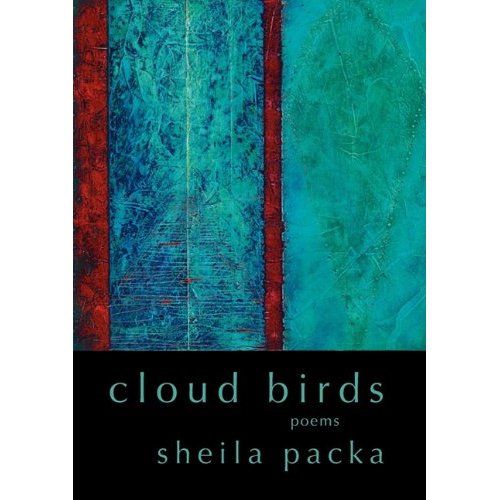
Cloud Birds


Cloud Birds

For me, this book of poems grapples with fear.  I've arranged the poems into three sections: 'bear,' 'wing,' and 'cloud.'  The poems in the first section are about encounters: fear of the wilderness, especially bears, fear of women, and fear of relationships. The pomegranate, the myth of Persephone, and the migration of Persephone between her husband in Hades and her mother enter into the book.  Some of the poems in Cloud Birds are about women moving through violence; all of the poems are about moving through fear.

This is not about victimization, but about learning how to walk through violence and fear and get beyond it. My grandmother on my mother's side survived spousal abuse. I had a brief marriage, at age 20, to a man who, on our honeymoon, kicked me because the suitcase was not packed correctly.  I have known so many who have suffered and even lost their lives to this violence.  

The painting on the cover of the book by visual artist Cecilia Ramon is called "Refuge I/ Refugio I (in homage to Ana Mendieta).  Cecilia Ramon, the visual artist, migrated from Buenos Aires, Argentina. When she was young, she witnessed violence on the streets. During that era, many people 'were disappeared.'   The concept of refuge is apt.  Ana Mendieta was an important visual artist. She was born in Havana, Cuba, and she came to the United States at the age of 12 without her parents.  She became an environmental artist with striking work.  Click for info about Ana Mendieta, visual artist.  Her death was mysterious.  She died from a fall from her apartment window in NYC. Her husband was charged with murder, but acquitted. Perhaps she did commit suicide.  But that too is the extreme act of violence toward the self.  I wrote the poem "Spilled" for her, for many others, who don't survive. 

The section, Wing, is a migration through the Iron Range and the places in northern Minnesota where I grew up and lived. The Iron Range is a place of iron and taconite mines. It was a working class culture--sexist, racist, and homophobic.  Drinking was a major preoccupation.  But it is also a beautiful landscape with people, native and immigrant, of great resilience and strength. This section has stories about love and about my parents and immigrant grandparents. They never achieved English literacy; my grandmother and I weren't able to converse across the language divide.  Some poems pay homage to my father; the first protector in my life and the first to threaten violence.  He loved me fiercely.  When one steps back from the family and looks into the landscape, one sees violence in nature, predators and prey in a relationship phrased as "the way life is."  I mull over these things.  In the section are poems about factory work and an underground mine, dangerous work with horrible health consequences.  Recently, studying cosmology, I read that the creation of the universe was a simultaneous creation and destruction. It's everywhere. There is every reason to have fear and every reason to live one's life fully. 

The last section, Cloud, is a sequence of poems about dissolved boundaries: between lovers, between walls that one puts up, between the immigrant past and the present, between the self and the landscape. In this section, the poem Persephone speaks of returning. When my mother was alive, I went home to her a few times. When relationships were difficult. Now that she is gone, I continue to revisit her origins.

In order to overcome my own fear of bears (because I had moved into the woods and shared the landscape with several), I decided to write twenty one love poems to bears. This is the origin of the manuscript--and its end--the decision to love what I had feared.  

Cloud Birds is published by Wildwood River Press and is available at your local bookstore, or at Amazon.com